
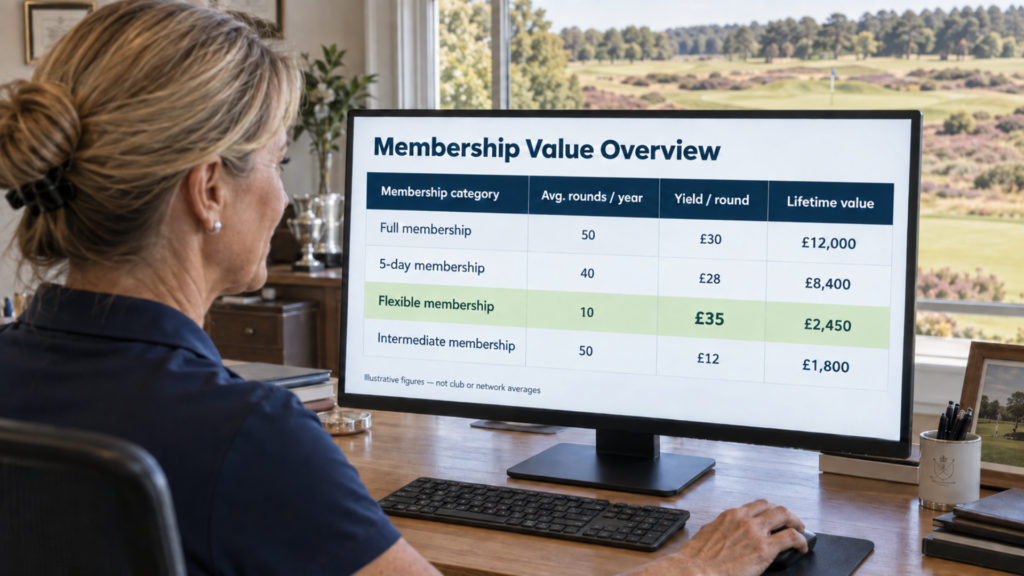
When a committee asks what a flexible member is worth, the first figure usually available is their annual fee. It is easy to report and compare with other membership categories. But it tells you very little about what that golfer might contribute over several years.
A member may renew, bring paying guests, spend in the clubhouse and eventually move into full membership. If those activities sit in separate reports, the original joining fee can become the only value anyone sees.
For golf club managers, measuring flexible member lifetime value helps put acquisition budgets, retention activity and the role of the category on a firmer commercial footing.
Lifetime value considers the financial contribution of a member throughout their relationship with the club. Start with retained membership income, including renewals and top-ups, then add the margin from other attributable spending. Deduct acquisition and servicing costs that have not already been accounted for.
Use the amount your club retains after relevant fees or commission, rather than the headline price paid by the golfer. Our financial white paper makes this distinction between the membership transaction and retained home revenue.
Keep revenue and contribution separate. A £30 clubhouse sale does not produce £30 of profit. Likewise, unused points are already part of the membership payment; they are not extra income to add again.
Consider an illustrative group of 100 new flexible members. Suppose 75 renew for a second year and 60 of the original group remain for a third. That produces 235 paid membership years.
At an assumed £250 retained membership income per paid year, the group generates £58,750 over three years, or £587.50 per original joiner. This excludes additional spend and further costs. Please note this is just an example.
The denominator matters: include everyone who originally joined, including those who left. Looking only at continuing members overstates value. This is also a three-year measure, rather than a completed lifetime calculation.
Renewal is something clubs can influence. Check whether members have started playing, can find suitable tee times and know who to contact. A golfer who rarely books may need help well before their renewal reminder arrives.
Link member records to spending where your systems allow. Food and drink, shop purchases and guest visits can all reveal value missing from the subscription report.
Apply the relevant margin to sales, and only include the share that benefits the club. Spending with an independently operated professional shop or caterer may support the wider club community without producing the same direct return to club finances.
Be careful with guest rounds too. If a member uses points to bring a guest, the round should not automatically be recorded as an additional green fee. Count separately paid guest fees and attributable spending without duplicating the original points income.
A member who introduces a friend creates another opportunity to build club revenue. Ask new joiners how they heard about you and record the referring member when known.
Track completed joins and any referral reward costs. Keep referred members’ income in their own records, with the referral source linked. Adding their entire future value to both members would inflate the club total.
Some golfers will want more access as their circumstances change. Repeated top-ups or more frequent play can prompt a useful conversation about whether full membership now suits them better.
Record an upgrade as continued membership of the club. A flexible category report that counts every upgrade as a lost member hides a commercially valuable outcome.
From the upgrade date, count the actual income from the new category, allowing for any credits or adjustments. Do not forecast both a flexible renewal and a full subscription for the same period. Equally, a golfer who keeps renewing flexibly can remain valuable without ever upgrading.
The cheapest member to recruit will not necessarily make the strongest contribution. Compare acquisition sources using what their members retain and spend over the same period, alongside renewal and upgrade outcomes. Include the full customer acquisition cost, including marketing and staff follow-up time, counting each expense once.
Start with a simple quarterly review of each joining group: original joiners, retained membership income, renewals, upgrades, additional margin and costs. Where spending cannot be reliably attributed, show the gap rather than inventing an average.
Also check whether the revenue is genuinely additional. A regular visitor switching category may replace existing green fees. Play in a quiet afternoon slot has different implications from a booking that displaces higher-value demand.
Use observed results to build cautious forecasts and set an acceptable payback period. Future renewals should inform investment, but they cannot fund today’s bills until they happen.
Before deciding what to spend attracting flexible members, follow one joining group beyond its first payment. The resulting picture will show where the category contributes, where value is being missed and which parts of the member experience need attention.
Want to review how flexible membership fits your club’s revenue and retention plans? Speak to the PlayMoreGolf team.
We use cookies to improve your experience. You can accept or reject non-essential cookies.