
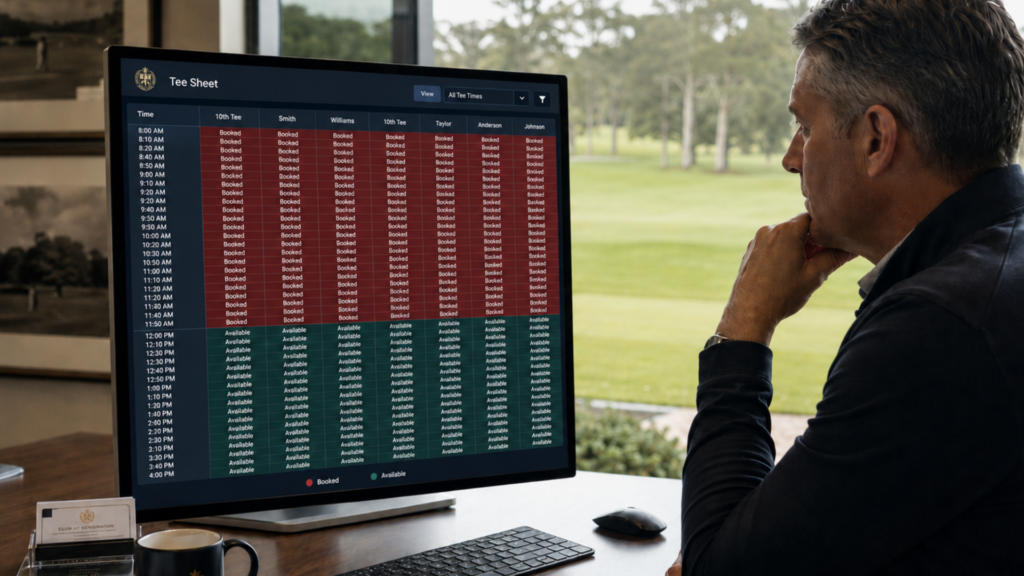
Golf clubs naturally spend a great deal of time focusing on peak-time demand.
Saturday mornings are monitored carefully. Prime tee times are protected. Visitor pricing is regularly reviewed.
Yet one of the biggest commercial opportunities on the tee sheet can receive far less attention:
The quieter afternoon tee times that remain unbooked week after week.
A vacant tee time might not feel like an immediate problem. There is no cancellation to manage and no visible financial loss appearing on a report.
However, under-utilised afternoon inventory can create a hidden form of value leakage that quietly affects revenue throughout the year.
When clubs review their performance, the focus naturally falls on the revenue that has been generated.
How many green fees were sold?
How many new members joined?
Did visitor income reach budget?
What is harder to see is the revenue that was never generated in the first place.
When an afternoon tee time passes without a booking, the opportunity simply disappears.
Golf inventory cannot be stored or carried forward. If Tuesday afternoon at 2.40pm goes unused, the club has permanently lost the opportunity to generate income from that slot.
One unused tee time may appear insignificant. Repeated across several afternoons, multiple weeks and an entire season, the commercial impact can become considerable.
A club can appear busy overall while still leaving substantial value on the table.
A healthy Saturday diary can easily disguise weaker utilisation during other parts of the week.
It is therefore worth looking beyond overall rounds played and considering where those rounds are taking place.
How full are weekday afternoons?
How much twilight availability regularly remains unused?
Which periods consistently have space within 48 hours of play?
Are some sections of the tee sheet generating significantly less revenue than others?
The challenge is not always a lack of demand for golf.
It may simply be a lack of repeatable demand for particular times of the day.
Understanding that difference can provide a much clearer picture of the club’s commercial opportunity.
The traditional response to spare capacity has often been to reduce the green fee, launch a special offer or send a last-minute promotion.
These tactics can occasionally generate additional bookings, but they can also create new challenges.
Frequent discounting may encourage golfers to wait for an offer rather than book at the standard rate. It can reduce perceived value, make forecasting more difficult and place pressure on pricing elsewhere.
It also means the club must create fresh demand every time another gap appears on the tee sheet.
A more sustainable approach is to develop repeatable demand that regularly makes use of quieter inventory.
This is where flexible membership can play a valuable role.
There are many golfers who do not play frequently enough to justify a traditional full membership, but who play too regularly to remain purely occasional green-fee customers.
They sit in an often-overlooked middle ground.
An appropriately structured flexible membership category can give these golfers a stronger connection to the club while encouraging repeat play during quieter periods.
The aim is not to fill every available tee time or to compete with the club’s premium membership categories.
It is to generate value from inventory that may otherwise remain unused.
When structured correctly, flexible membership can support:
Clear access rules, points values and availability restrictions can also help clubs protect peak-time inventory and maintain a meaningful distinction between flexible and full membership.
Rounds played are an important measure, but they do not tell the whole commercial story.
A more useful question is:
What value is each section of the tee sheet generating?
An afternoon tee time used by a golfer who has already made an annual financial commitment to the club may deliver more overall value than a vacant slot being held in the hope of a visitor booking that never arrives.
That value may extend beyond the round itself.
The golfer may bring guests, purchase food and drink, visit the pro shop, attend club events or eventually progress into another membership category.
This becomes particularly relevant during periods of unpredictable weather or economic uncertainty, when relying heavily on ad-hoc visitor demand can create greater revenue volatility.
The opportunity is often larger than it initially appears.
Filling only a handful of additional afternoon tee times each week can generate meaningful annual revenue while making better use of an asset the club already owns.
No additional land is required.
No new facilities are needed.
No major capital investment is involved.
The inventory already exists.
The commercial opportunity comes from helping it work harder.
Most golf clubs understand the importance of protecting peak-time demand.
Quieter periods of the week do not always receive the same level of commercial attention.
Yet it is often during these under-utilised afternoons that value quietly leaks from the business.
By understanding where availability consistently exists, measuring the commercial performance of different tee-time periods and creating structured ways to generate repeat demand, clubs can improve utilisation without relying on constant discounting.
Because the biggest opportunities are not always found in the busiest parts of the tee sheet.
Sometimes, they are hidden in the tee times nobody is talking about.
We use cookies to improve your experience. You can accept or reject non-essential cookies.