
Your committee agrees next year’s membership revenue target. The figure goes into the budget, and the club starts planning how to spend it.
But the category details are still being discussed. Nobody has approved the marketing budget. Enquiries go into a shared inbox, without anyone specifically responsible for following them up.
The income has been forecast before the club is ready to generate it.
As golf clubs across the UK and Ireland prepare for 2027, this is a gap worth addressing now. Golf membership revenue targets need an agreed offer, a realistic recruitment plan and people responsible for delivering each step.
Start by separating expected renewal income from the money new members must generate. Allow for resignations and movement between categories before calculating the recruitment requirement.
Consider a simplified example:
| Planning measure | Illustrative figure |
|---|---|
| Income required from new members | £40,000 |
| Average income retained per new member | £400 |
| New members required | 100 |
| Enquiry-to-join conversion rate | 25% |
| Enquiries required | 400 |
These are planning assumptions, not recommended prices or industry benchmarks. Use your own category mix, deductions and conversion results. Check joining dates and membership terms before assuming the full annual value falls within the budget year.
Our article on how many new members your club needs explains the calculation in more detail.
The next question is practical: can your marketing and sales process produce those enquiries and convert them within the time available?
Before promotion begins, confirm the category structure, price, membership term and eligibility criteria.
For flexible membership, that also means agreeing the points allocation, points required to play, booking windows, access restrictions and top-up arrangements. Explain how the category differs from full membership and which golfers it suits.
Check the available tee times by season. A category designed around quieter summer afternoons needs a clear explanation of what members can book during shorter winter days.
Staff should be able to give the same answers whether a golfer contacts the office, professional shop or membership team. Unresolved rules create inconsistent advice and delay decisions to join.
“Discuss at the next meeting” is not a launch timetable.
Work backwards from the date recruitment needs to begin. Identify who can approve the proposal, when papers must be submitted and which decisions require committee agreement.
An illustrative timetable for a January campaign could be:
Adapt this to your committee calendar and membership year. If approval moves back a month, review the sales forecast as well. A delayed launch leaves less time to generate the budgeted income.
The clocks have just gone back, bringing earlier evening darkness. Shorter playing days and weather disruption make it particularly important to explain how membership fits a golfer’s actual availability.
Avoid assuming that summer campaign messages will work unchanged through winter.
Explain when golfers can play, what membership includes and when it starts. Where a later start date is available, make the terms clear.
Allow time for photography, copy, landing pages, advertising setup and staff training. Include campaign costs and staff time in the plan.
Previous enquiries and repeat visitors can provide a useful audience where marketing permissions allow. Keep generating interest through winter, with follow-up timed around each golfer’s intentions.
One person should be accountable for the overall recruitment target. Individual responsibilities should then cover:
One employee may cover several tasks, but every task needs an owner and holiday cover.
Agree handovers between the club and any external provider. A golfer who says they want to join still needs a clear route through payment and membership setup.
A CRM should show what happens next, not simply store contact details.
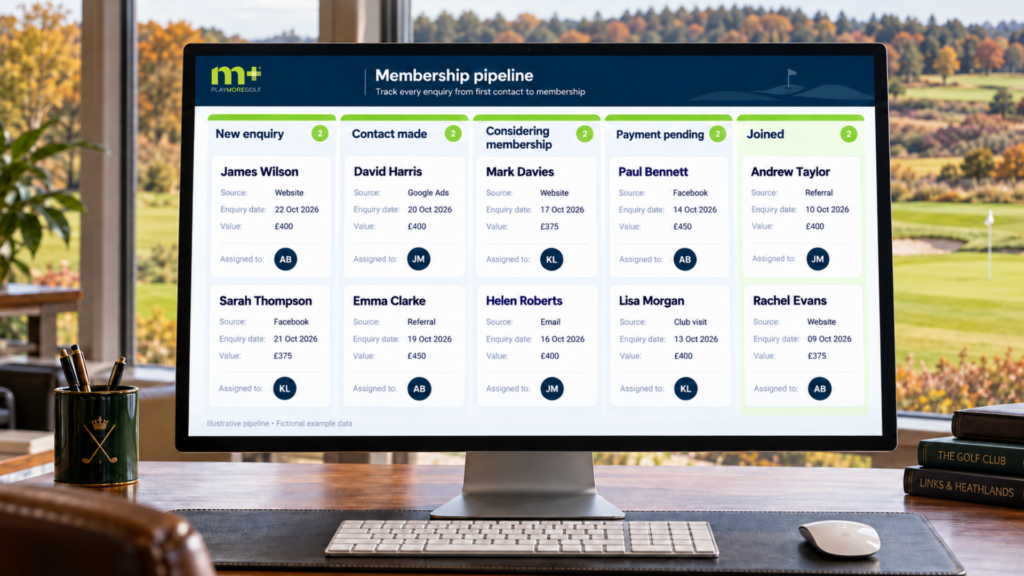
Use clear stages: New enquiry → Contact made → Considering membership → Payment pending → Joined, with separate outcomes for Not proceeding and Revisit later.
Define “Joined” consistently, including confirmed payment arrangements and activation. Record an owner, next action and due date for every open enquiry.
Set achievable service standards before launch. For example, acknowledge enquiries immediately, provide a personal response within one working day and agree a follow-up date during the first conversation.
Schedule onboarding promptly after activation. Our guide to managing a flexible membership category after launch explores the ongoing work involved.
Review new enquiries, response times, overdue follow-ups, payments pending and completed joins weekly.
Each month, compare joiners by category, conversion rates, acquisition costs and income against the phased budget. Agree targets and who will act when results fall behind.
Alongside the revenue budget, show expected cash receipts by month. A January enquiry may not become a paying member until March. Instalments and provider settlement terms can also change when money reaches the club.
Keep annual membership value, recognised revenue and cash received distinct. If recruitment slips, update the cash forecast.
Before signing off next year’s membership budget, ask: could the team start delivering this plan tomorrow?
If prices, approvals, campaigns or responsibilities remain unresolved, the forecast depends on work that has not yet been completed.
Where flexible membership could help your club recruit occasional golfers into suitable tee times, speak to PlayMoreGolf about the category and the support needed to deliver it.
A credible target comes with agreed actions, named owners and dates.
We use cookies to improve your experience. You can accept or reject non-essential cookies.